Inside the Louvre
Eight things genuinely worth making time for
The mistake is trying to see everything. The Louvre works better when you choose several major works, connect them through nearby galleries, and leave enough time for the palace interiors and collections you discover along the way.
01
Denon wing
See the Mona Lisa — but look around the Salle des États too
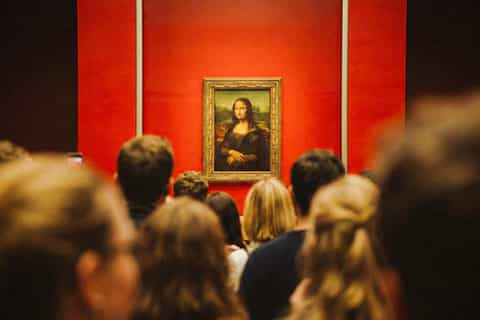
Leonardo da Vinci’s Mona Lisa is the museum’s most famous painting and naturally attracts one of its largest crowds. Seeing it is worthwhile, but the room itself rewards more attention than many visitors give it.
Directly opposite the Mona Lisa is Paolo Veronese’s enormous Wedding Feast at Cana. Its monumental scale makes an interesting contrast with Leonardo’s comparatively small portrait.
Better approach
See the Mona Lisa, then turn around before leaving. Many visitors walk straight out and miss one of the most visually impressive paintings in the room.
02
Daru staircase
Approach the Winged Victory of Samothrace from below
The Winged Victory is not simply another sculpture displayed in a gallery. It stands above the monumental Daru staircase, giving the approach almost as much impact as the work itself.
Rather than rushing directly toward it, stop lower on the staircase. The distance helps you appreciate how the sculpture, stairs and palace architecture have been composed together.
Why it stands out
The sculpture’s elevated position makes this one of the Louvre’s strongest combinations of artwork and architectural setting.
03
Sully wing
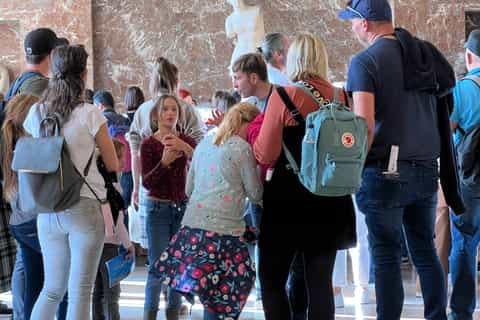
See the Venus de Milo among the Greek antiquities
The Venus de Milo is one of the Louvre’s best-known ancient sculptures and has been part of the museum’s collection since the early nineteenth century.
Do not treat it only as a photograph stop. Spend a few minutes in the surrounding Galerie des Antiques, where the sculpture becomes part of a much broader introduction to Classical and Hellenistic Greek art.
Good to combine with
Other Greek antiquities in the Sully wing rather than crossing immediately back to the busiest painting galleries.
04
Egyptian antiquities
Walk beyond the Sphinx into ancient Egypt
The Great Sphinx of Tanis is an impressive introduction, but it should be the beginning rather than the end of your Egyptian visit.
The department extends across two levels and covers thousands of years of Egyptian civilization, including monumental sculpture, sarcophagi, religious objects, everyday objects, writing and royal imagery.
Best if you have time
Allow at least one focused block of your visit for Egypt instead of trying to absorb the collection while moving between unrelated highlights.
05
Palace interior
Walk through the Galerie d’Apollon
The Louvre is not only a container for art. It is also a former royal palace, and the Galerie d’Apollon is one of the places where that history becomes visually obvious.
Look upward as much as at the display cases. The gilded decoration, painted ceiling and ceremonial scale make the gallery a destination in its own right.
Why include it
It changes the visit from “seeing artworks in a museum” to understanding that you are moving through a historic palace.
06
Richelieu wing
Slow down beneath the glass roofs of Cour Marly and Cour Puget
These vast internal courtyards display French sculpture beneath large glass roofs. Many of the sculptures were originally intended for outdoor settings, including royal gardens and important Parisian spaces.
Their scale is easier to appreciate here than when sculptures are packed into conventional gallery rooms.
Good crowd break
These spaces can feel visually calmer than the route connecting the Mona Lisa and the major Denon-wing masterpieces.
07
French painting
Give the enormous French canvases enough distance
Works such as Géricault’s Raft of the Medusa are easy to underestimate when you stand too close. The large nineteenth-century galleries are designed for paintings that need viewing distance.
Walk toward the centre or back of the room before judging a work. Composition, scale and movement become much easier to read when the whole canvas fits comfortably within your view.
Simple visitor tip
For very large paintings, step back first and only then move closer for individual details.
08
Outside the galleries
Finish with the Pyramid, Cour Napoléon and the palace exterior
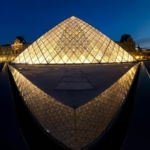
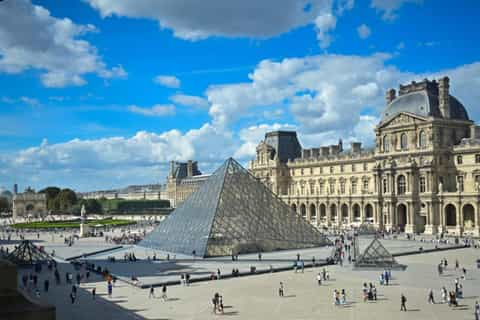
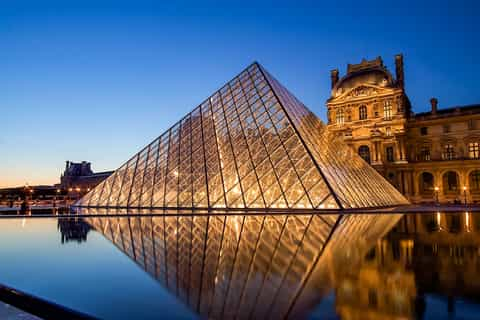
Do not let the visit end the moment you leave the galleries. The glass Pyramid sits within the historic Cour Napoléon and works best when viewed as part of the much older palace surrounding it.
Walk far enough across the courtyard to see the modern Pyramid, palace façades and open space together rather than photographing it only from the entrance queue.
Best moment
Use the exterior as the final part of your visit when you no longer need to worry about finding rooms or keeping to a museum route.